Why Advisory Firms Need More Than Software to Scale

Most advisory firms know they need better technology.

That part is not really up for debate anymore. Between increasing regulatory pressure, rising client expectations, fragmented systems, and the everyday chaos of running an advice business, relying on spreadsheets, inboxes, and “ask Sarah, she knows how we do this” is no longer a scalable operating model.

But here is the bit that often gets missed:

Software alone does not transform an advisory firm.

It can help. It can automate. It can bring structure, visibility, and consistency. But if the software is dropped into the business without the right expertise around it, the result is usually underwhelming.

Processes stay inconsistent. Advisers still find workarounds. Compliance teams still chase missing records. Client communication still depends on whoever remembered to send the update. And everyone quietly wonders why the shiny new system has not delivered the promised efficiency.

The answer is simple: advisory firms do not just need technology. They need an ecosystem of support.

Technology Is Only One Part of the Solution

Financial advisory firms operate in a complicated environment.

There are regulatory obligations to meet. Client records to maintain. Suitability requirements to evidence. Reviews to complete. Documents to collect. Communications to store. Marketing activity to manage. Client expectations to meet. Advisers to support. Leadership teams to reassure.

That is why implementing advice software is not just a technical project. It is a business project, a compliance project, an operational project, and a client experience project all at once.

A system may be technically capable, but if it does not reflect how advice is actually delivered, it will not be used properly. If workflows do not align with regulatory obligations, compliance risk remains. If the adviser experience is clunky, adoption suffers. If client communications are not supported, the client experience still feels fragmented.

This is where many firms get stuck. They focus on the software itself, but not on how that software fits into the wider business.

The Problem With “Just Implementing a System”

In theory, a new system should make life easier.

In practice, it often depends on how it is implemented.

If an advisory firm introduces new software without properly mapping its workflows, training its teams, aligning its compliance processes, and planning client engagement, the system can quickly become another tool in an already crowded technology stack.

That leads to familiar problems:

  • Advisers only use part of the system.
  • Admin teams continue duplicating work.
  • Compliance evidence is still scattered.
  • Client communication remains inconsistent.
  • Management does not get the visibility it expected.
  • The business does not realise the efficiency gains it was promised.

In other words, the firm has bought the technology, but not changed the operating model.

And that is the real issue.

Modern advisory firms do not need more isolated tools. They need connected systems, structured processes, and the expertise to bring those processes to life.

What a Proper Support Ecosystem Looks Like

The most successful firms understand that technology must be supported by expertise across several areas.

First, there is business implementation. This is about understanding how the firm actually works: how advisers manage clients, how onboarding happens, how reviews are triggered, how tasks are assigned, and where bottlenecks appear. Without that understanding, even a strong system can be configured in a way that looks neat on paper but fails in the real world.

Then there is technical capability. Advisory firms need systems that are reliable, secure, and designed with data protection and operational resilience in mind. This includes considerations around GDPR, DORA, integrations, access control, system performance, and long-term maintainability.

There is also compliance alignment. Advice workflows cannot be built in isolation from regulation. MiFID and IDD firms need processes that support suitability, record-keeping, ongoing reviews, client classification, documentation, approvals, and auditability. Compliance should not be something that happens after the work is done. It should be built into the workflow.

Finally, there is marketing and client engagement. A firm may have strong advice processes, but if client communication is inconsistent, the experience still feels disjointed. Client updates, campaigns, announcements, onboarding messages, and service communications all form part of the wider client relationship.

This is the difference between software implementation and business transformation. One installs a system. The other improves how the firm operates.

Where PlutoIFA Fits In

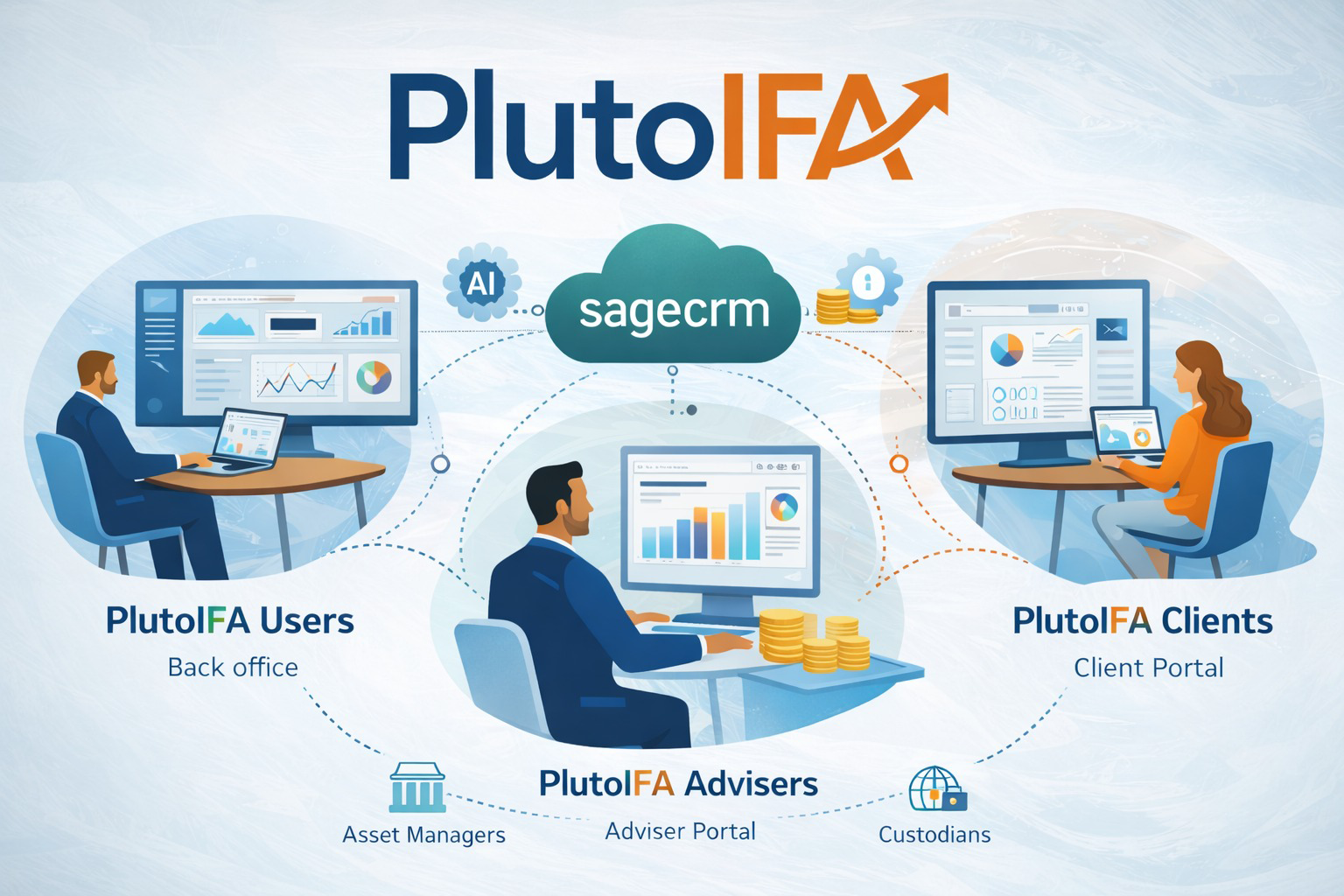
PlutoIFA is designed for financial advisory and investment advisory firms that need more than disconnected tools and manual processes.

Built on Sage CRM, PlutoIFA automates key tasks across multi-jurisdictional and multi-lingual advisory firms. It supports configurable workflows that can adapt to the business model of the firm, rather than forcing the firm into a rigid, one-size-fits-nobody structure.

Out of the box, PlutoIFA includes a comprehensive core workflow covering marketing, customer onboarding, AML, suitability, knowledge and experience assessments, asset allocation, proposals, signing terms of business, client servicing throughout the agreement, and exit.

That matters because advisory firms do not operate in isolated moments. A client relationship is a lifecycle. Marketing leads to onboarding. Onboarding leads to advice. Advice leads to reviews. Reviews lead to ongoing servicing. Servicing eventually leads to exit or renewal.

When each stage is handled in a different system, consistency suffers. When the full lifecycle is governed in one connected environment, the firm gains better control.

The PlutoIFA presentation positions this clearly: the system supports client relationship management, advice workflows, and compliance unified on Sage CRM, with human-led advice augmented by AI. It also highlights the need to reduce cost, risk, and duplication across onboarding, reviews, communications, documents, and client engagement.

Supported by the Right Expertise

The strength of PlutoIFA is not only the software. It is the support structure around it.

PlutoIFA is supported by a business implementation team with deep understanding of MiFID and IDD regulation. This helps firms structure workflows around the realities of regulated advice, rather than treating compliance as a box-ticking exercise at the end.

It is supported by a technical team focused on system reliability, data protection, security, and compliance considerations linked to GDPR and DORA. That technical foundation is essential for firms operating in regulated markets where resilience and governance matter.

It is supported by a compliance team that helps align workflows and processes with regulatory obligations. This means the system is not just helping advisers move faster; it is helping the business maintain better oversight and evidence.

It is also supported by a marketing team that helps firms improve client engagement. Because client experience is not just about portals and dashboards. It is also about how clearly, consistently, and professionally a firm communicates.

That combination is important. Advisory firms need tools, yes. But they also need people who understand what those tools are supposed to achieve.

AI Should Enhance Advisers, Not Replace Them

There is a lot of noise around AI in financial services. Some of it useful. Some of it breathless. Some of it sounds like it was written by someone trying to replace an entire advice firm with a toaster.

PlutoIFA takes a more practical approach.

AI is there to support advisers, not replace them. It can help with meeting transcription, summarising communications, preparing for reviews, identifying follow-ups, and supporting the creation of reports or client-facing documents. But the adviser remains central.

That is the right balance. Clients still need human judgement, context, empathy, and professional accountability. AI can reduce administrative strain and improve consistency, but it should not remove the adviser from the advice relationship.

For advisory firms, this matters because the goal is not to automate the humanity out of advice. The goal is to give advisers more capacity to focus on the work that genuinely requires their expertise.

The Real Goal: Better Control, Better Efficiency, Better Client Experience

When technology is supported by the right ecosystem, the benefits become much more tangible.

Advisers can work from clearer processes. Compliance teams can access better records. Management can see what is happening across the business. Clients receive a more consistent experience. Reviews, documents, tasks, communications, and reporting become easier to manage.

The firm becomes less dependent on individual memory and manual effort.

That is especially important for firms operating across jurisdictions, languages, and regulatory frameworks. Consistency becomes harder as firms grow. Without structured workflows, every adviser, office, or region can start operating slightly differently. Over time, those small differences create risk, inefficiency, and confusion.

A governed system helps standardise the client lifecycle without removing flexibility. That is the sweet spot: enough structure to create control, enough configurability to reflect how the firm actually operates.

Software Does Not Deliver Value by Itself

The firms that get the most value from technology are not necessarily the ones that buy the most features.

They are the ones that implement properly.

They understand their workflows. They align their processes with regulation. They train their teams. They support client engagement. They use automation where it adds value. They keep advisers in control. They treat the system as part of the firm’s operating model, not as a separate IT project.

That is why advisory firms need an ecosystem of support.

Because the goal is not simply to have better software.

The goal is to run a better advisory business.

Get the latest PlutoIFA insights on regulated advice, operational efficiency, AI-supported workflows, and digital client engagement delivered straight to your inbox.