Why Hiring More Advisers Is No Longer the Best Way to Grow

When a financial advisory firm reaches capacity, the instinct is often simple: hire more advisers.

It makes sense on the surface. More advisers should mean more clients served, more revenue generated, and more room for growth. For years, this has been the default approach for many advisory businesses.

But the industry has changed.

Regulatory expectations are higher. Clients expect faster, clearer, and more consistent service. Advisers are spending more time on administration, documentation, reviews, suitability requirements, and follow-ups. At the same time, firms are under pressure to grow without allowing costs to spiral.

In that environment, hiring more advisers is not always the smartest route to scale.

Sometimes, it simply gives the business more people to manage, more variation to control, and more complexity to absorb.

The Hidden Problem With Headcount-Led Growth

Hiring can solve a capacity problem in the short term. But it often creates new problems in the background.

Every adviser brings their own way of working. Their own habits. Their own note-taking style. Their own approach to client communication, follow-ups, reviews, and documentation.

That variation may seem manageable when the firm is small. But as the business grows, inconsistency becomes harder to control.

Management needs better visibility. Compliance needs stronger evidence. Clients expect a smoother experience. Advisers need to stay productive without being buried in admin.

The more the firm grows through headcount alone, the harder it becomes to maintain a consistent operating model.

And then there is cost.

More advisers mean more salaries, more onboarding, more training, more management time, and more operational support. Revenue may grow, but so do fixed costs. If the underlying way of working does not improve, profitability can become harder to protect.

In other words, growth becomes tied directly to headcount.

That is not true scalability. That is just getting busier with a bigger payroll.

The Better Question: How Can Advisers Do More Without Being Stretched Thinner?

The future of growth in financial advice is not about replacing advisers. It is about helping advisers work more efficiently, consistently, and intelligently.

That means shifting the question from:

“How many more advisers do we need?”

to:

“How can we improve the way our advisers work?”

This is where structured systems and workflows become critical.

A firm that relies on individual effort alone will always be limited by time, memory, and manual follow-up. A firm that uses governed workflows can create a more consistent way to deliver advice across the business.

That does not remove the human adviser from the process. Far from it.

It gives advisers a better working environment.

Instead of chasing documents, manually tracking next steps, searching through emails, or rebuilding the same process for every client, advisers can work within a structured system that guides the client lifecycle from beginning to end.

Growth Becomes Operational, Not Just Recruitment-Led

When firms improve how advice is delivered, they increase capacity without simply adding more people.

This can mean:

  • Reducing time spent on administration
  • Standardising key advice workflows
  • Making onboarding and reviews easier to manage
  • Improving visibility across advisers and clients
  • Keeping documentation stored, structured, and auditable
  • Helping advisers prepare for meetings faster
  • Making follow-ups and tasks easier to track

The result is a more scalable business model.

Advisers can serve more clients without the firm losing control. Clients receive a more consistent experience. Management has better oversight. Compliance becomes easier to evidence. Growth becomes less dependent on constantly expanding the team.

That is the real shift.

The goal is not fewer advisers. It is better-supported advisers.

Why Structure Matters in Financial Advice

Financial advice is not a loose collection of tasks. It is a regulated, multi-stage client journey.

From marketing and onboarding to AML checks, suitability, knowledge and experience assessments, asset allocation, proposals, terms of business, ongoing reviews, servicing, and exit, every stage matters.

If these processes live in spreadsheets, inboxes, documents, and individual advisers’ heads, the firm becomes vulnerable to inconsistency.

A structured workflow changes that.

It gives the firm a shared way of working. It helps ensure important steps are completed. It makes information easier to find. It creates a clearer audit trail. It reduces duplication and helps advisers focus on client judgement rather than process management.

That is how firms grow without turning into operational spaghetti. Delicious in theory. Dangerous in compliance.

Where PlutoIFA Fits In

PlutoIFA has been built to support advisory firms that want to scale in a more structured way.

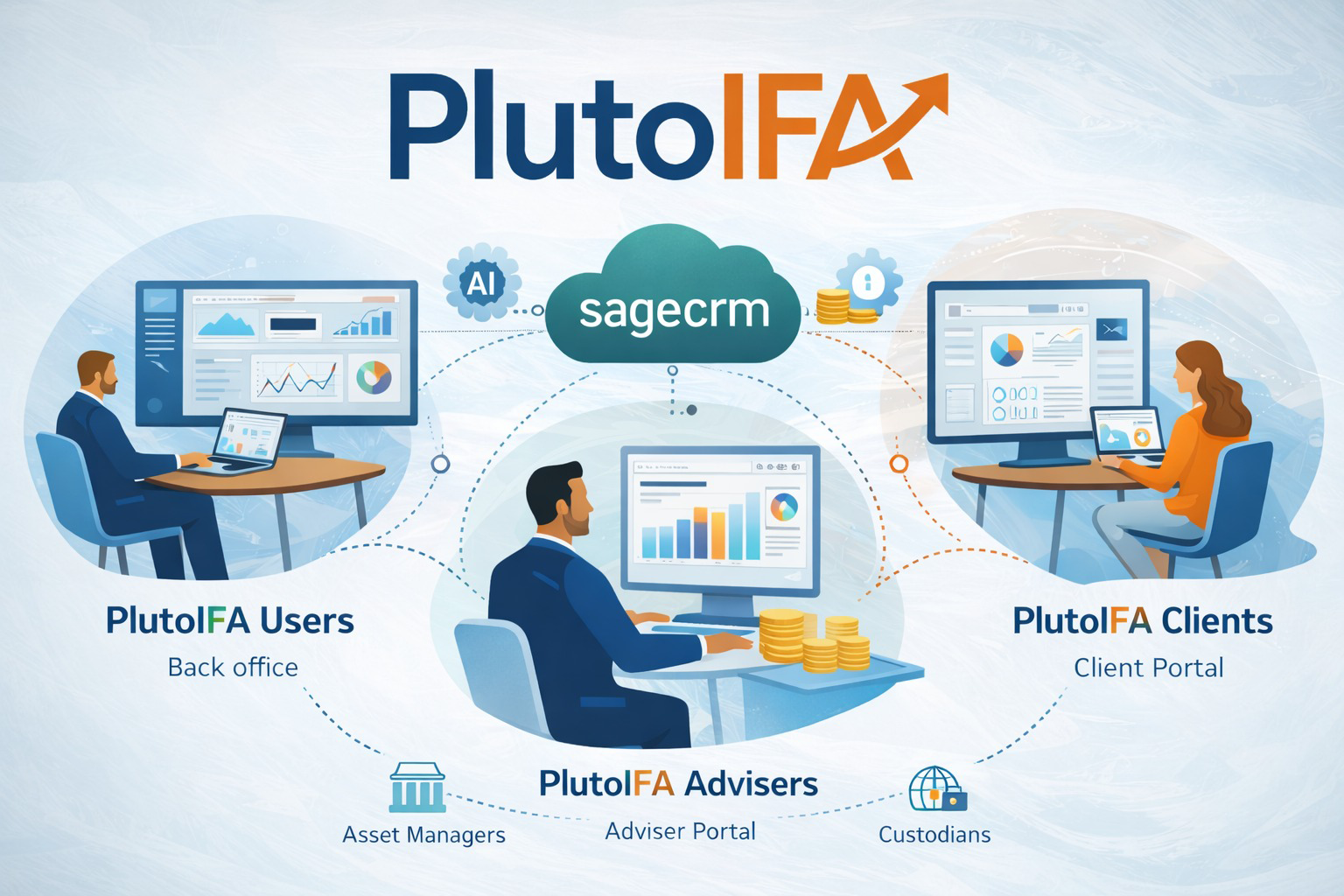
Built on Sage CRM, PlutoIFA helps financial and investment advisory firms manage the full client lifecycle in one governed system. It is designed for multi-jurisdictional and multi-lingual firms, with configurable workflows that can adapt to the firm’s business model.

Out of the box, PlutoIFA includes a comprehensive workflow covering marketing, client onboarding, AML, suitability, knowledge and experience assessments, asset allocation, proposals, signing terms of business, ongoing client servicing, reviews, and exit.

It brings together adviser workflows, client engagement, compliance processes, reporting, document management, and operational oversight.

The focus is simple: help advisers work more efficiently without removing the human judgement at the centre of advice.

PlutoIFA also uses AI to support advisers, not replace them. This can include helping with meeting preparation, summaries, notes, follow-ups, document generation, and reporting support. The adviser remains in control, while the system helps reduce the administrative weight around them.

Scaling Advice Without Scaling Complexity

Hiring will always have a place in growing advisory firms. There comes a point where more people may genuinely be needed.

But hiring should not be the only growth strategy.

If a firm’s processes are inconsistent, adding more advisers can multiply the inconsistency. If compliance evidence is difficult to manage, more advisers can create more documentation pressure. If client servicing depends too heavily on manual effort, growth can quickly become expensive and inefficient.

The firms that scale successfully will be the ones that improve the operating model behind the advice.

They will structure delivery. Automate where appropriate. Keep information centralised. Support advisers with better workflows. Use AI carefully and practically. Maintain consistency across clients, advisers, and jurisdictions.

Most importantly, they will grow without losing control.

Final Thought

Hiring more advisers may increase capacity, but it does not automatically create scalability.

True growth comes from improving how advice is delivered.

For modern financial advisory firms, the opportunity is not simply to build bigger teams. It is to build smarter systems around the teams they already have.

That is how firms protect quality, improve efficiency, support advisers, and grow sustainably.

Get the latest PlutoIFA insights on regulated advice, operational efficiency, AI-supported workflows, and digital client engagement delivered straight to your inbox.