The Hidden Cost of Fragmented Systems in Financial Advice

Most Advisory Firms Don’t Have a Technology Problem

Most advisory firms believe they have a technology problem.

They look at the stack and see a CRM, a portfolio platform, email, document storage, reporting tools, workflow trackers and a few spreadsheets quietly holding the whole operation together. On paper, that sounds like a fully equipped business.

The problem is that each system is doing its own job in isolation.

The CRM holds one version of the client. The portfolio platform holds another. Documents sit in folders. Email contains half the relationship history. Tasks are tracked manually. Updates happen in one place but not another.

Nothing looks broken at first glance. Yet the adviser still has to piece everything together.

That is not a technology problem. It is a fragmentation problem.

Fragmentation Creates Friction

Fragmentation happens when systems, data and processes are disconnected.

Each tool may be useful on its own, but the firm loses control when those tools do not speak to each other. Advisers then spend too much time searching, checking, copying, reconciling and following up manually.

This creates a few familiar problems:

  • Client information is duplicated across systems
  • Data becomes outdated or inconsistent
  • Communication history is incomplete
  • Documents are scattered
  • Actions depend on manual reminders
  • Suitability evidence has to be reconstructed
  • Reviews rely too heavily on adviser memory
  • Compliance becomes a clean-up exercise rather than part of the process

None of these issues feels dramatic at the start. That is what makes them dangerous. Fragmentation does not usually cause one big operational failure. It creates hundreds of small delays, gaps and risks that build over time.

A little admin here. A missed update there. A review delayed by a spreadsheet no one trusts.

Very glamorous. Very financial services.

The Missing Piece Is a Single View of the Client

In advice, context matters.

A recommendation is only as strong as the information behind it. Advisers need to understand the client’s objectives, circumstances, risk profile, investment position, communication history, outstanding actions and previous advice.

When that information is spread across multiple systems, there is no single, reliable view of the client.

That makes everyday work harder. It also increases risk.

Suitability is a good example. Firms need to show why advice was appropriate at the time it was given, based on the client’s circumstances and needs. If that evidence lives across emails, documents, meeting notes, platform data and adviser memory, the firm is forced to reconstruct the story after the fact.

That is slow, stressful and vulnerable to gaps.

A connected system changes the model. Client data, documents, communications, tasks and workflows all sit within one governed environment. The firm can see what happened, when it happened, who did it and what still needs attention.

That is where control starts.

Why Adding More Tools Often Makes the Problem Worse

The instinctive response to operational friction is often to add another tool.

Need better reporting? Add a reporting tool.
Need task management? Add a workflow tool.
Need communication tracking? Add another platform.
Need client engagement? Add a portal.

Each decision can make sense in isolation. The trouble starts when every new solution adds another layer to the stack.

More tools can mean more logins, more integrations, more duplication and more places for information to go stale. Instead of simplifying the business, the firm creates a more complicated version of the same problem.

The issue is rarely the number of tools alone. It is the absence of structure between them.

For advisory firms, the goal should not be to collect technology. The goal should be to create a connected operating model.

What a Connected Advisory Firm Looks Like

A connected advisory firm runs on shared data, clear workflows and consistent processes.

That does not mean every firm should work in exactly the same way. Advisory businesses differ by jurisdiction, client type, service model, language, product range and internal structure.

The point is that the process should be governed by the system, not held together by individual effort.

In practice, this means:

  • Client data is captured once and used consistently
  • Workflows guide advisers through required steps
  • Documents and communications are linked to client records
  • Reviews are triggered and tracked systematically
  • Tasks and follow-ups are visible
  • Compliance evidence is created during normal work
  • Management can see activity, risk and progress across the firm
  • Advisers spend less time searching and more time advising

This gives firms a stronger foundation for growth. They can serve more clients without simply adding more headcount, more admin and more pressure.

Structure Is What Makes Scale Possible

Growth exposes weak processes.

A small firm can often manage fragmentation through effort. People remember where things are. Advisers know their clients personally. Admin teams develop workarounds. The spreadsheet survives another month.

As the firm grows, that model starts to crack.

More clients mean more reviews, more documents, more suitability checks, more communications, more tasks and more reporting requirements. Manual processes expand in every direction. The cost-to-serve increases quietly, and senior people become the safety net for operational gaps.

That is not scalable.

A structured system gives the firm a repeatable way to work. It reduces reliance on memory, personal habits and informal knowledge. It allows advisers to follow consistent processes across clients, teams and jurisdictions.

Scale does not come from asking people to work harder. It comes from reducing the amount of unnecessary work in the first place.

How PlutoIFA Supports a More Connected Advice Model

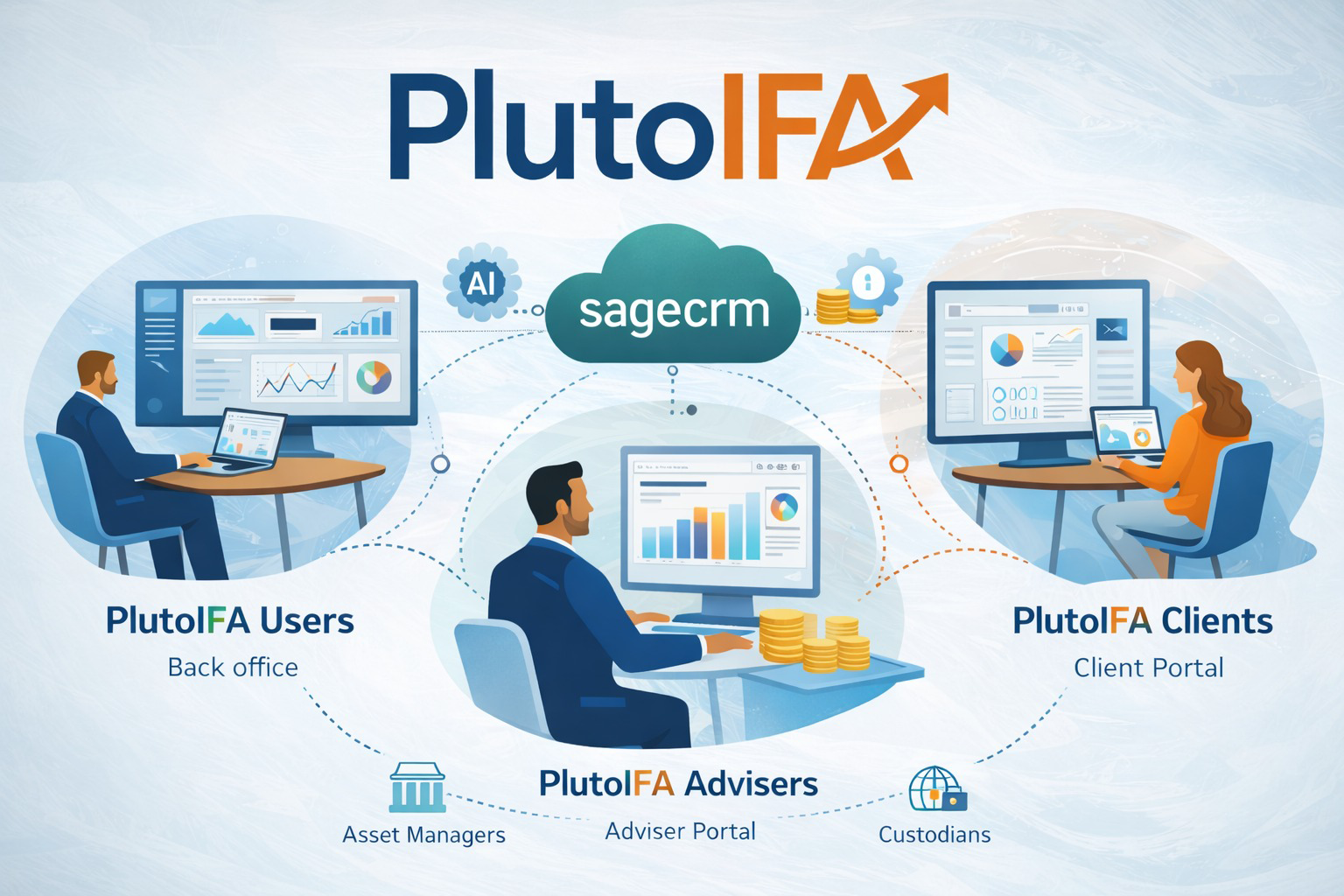
PlutoIFA is built to address fragmentation by bringing the advisory process into one governed environment.

Built on Sage CRM, PlutoIFA automates key tasks for multi-jurisdictional, multi-lingual advisory firms. It supports custom workflows that can adapt to the business model of the firm, rather than forcing every team into a rigid process.

Out of the box, PlutoIFA includes a comprehensive workflow covering:

  • Marketing
  • Client onboarding
  • AML checks
  • Suitability assessments
  • Knowledge and experience assessments
  • Asset allocation
  • Proposals
  • Signing terms of business
  • Client servicing during the lifetime of the agreement
  • Reviews and ongoing suitability
  • Client exit

This matters because advisory firms do not need another disconnected system. They need a structured environment where client data, adviser actions, documents, communications and compliance records work together.

PlutoIFA is also built around the principle that AI should support advisers, not replace them. AI can assist with meeting notes, communication summaries, review preparation, reports and client-facing documents. The adviser remains responsible for judgement, relationships and advice.

That is the right balance: human-led advice, supported by better systems.

Better Integration Means Better Control

The future of advice technology is not about having the longest software list.

It is about building a firm where information flows properly, processes are followed consistently and client records are complete.

Fragmentation makes firms slower, riskier and harder to scale. Connected systems give advisers, compliance teams and management a clearer view of the client and the business.

For advisory firms looking to grow, the question is no longer, “Which tool should we add next?”

The better question is: “How do we connect the work we already do into one governed process?”

That is where efficiency, compliance and scale start to move in the same direction.

Get the latest PlutoIFA insights on regulated advice, operational efficiency, AI-supported workflows, and digital client engagement delivered straight to your inbox.